

We handle Michigan lemon law and warranty defect claims for new and leased passenger cars, SUVs, pickup trucks, and vans across nearly every system in the vehicle: engines, transmissions, electrical and software, brakes and steering, airbags, and more. If your vehicle has been in the shop four or more times, or out of service 30 or more days, for the same unresolved problem, we want to talk to you.
The Vehicles We Handle
At Alexander Law, PLLC, we built our practice around a simple idea: if you paid for a vehicle that works, you’re entitled to a vehicle that works. Over the years we’ve represented Michigan drivers and lessees across nearly every make and model on the road, from economy sedans to full-size pickups.
Below is an overview of the vehicle types Michigan’s Lemon Law covers, the categories we typically cannot bring under that particular statute, and where we look instead when a vehicle falls outside it.
Vehicles Covered Under Michigan’s Lemon Law
Michigan’s Lemon Law (MCL 257.1401 et seq.) defines a covered “motor vehicle” narrowly. To qualify, the vehicle must be a passenger car, a sport utility vehicle, a pickup truck, or a van, and it must be new and covered by a manufacturer’s express warranty at the time you purchased or leased it. We regularly handle claims involving:
- New passenger cars and sedans
- SUVs and crossovers
- Pickup trucks, including full-size and heavy half-ton models
- Cargo and passenger vans
- Vehicles bought or leased for personal, family, or household use, and qualifying business fleets of fewer than 10 vehicles a year
Vehicles We Typically Handle Under Other Laws
The statute’s definition specifically excludes motor homes, buses, trucks other than pickups, and any vehicle designed to travel on fewer than four wheels. That means motorcycles, mopeds, RVs and motor homes, box trucks, and commercial buses fall outside Michigan’s Lemon Law.
We may still be able to help owners of these vehicles pursue a claim under the federal Magnuson-Moss Warranty Act, which applies to written warranties on almost any consumer product, or under a breach-of-warranty or revocation-of-acceptance theory.
| Vehicle Type | Michigan Lemon Law | Possible Alternative Remedy |
| Passenger car / sedan | Covered | — |
| SUV / crossover | Covered | — |
| Pickup truck | Covered | — |
| Cargo or passenger van | Covered | — |
| Motorcycle / moped | Not covered | Magnuson-Moss Warranty Act |
| Motor home / RV | Not covered | Magnuson-Moss Warranty Act |
| Box truck / heavy truck | Not covered | Magnuson-Moss Warranty Act / UCC breach of warranty |
| Commercial bus | Not covered | Magnuson-Moss Warranty Act |
New, Certified Pre-Owned, and Leased Vehicles
Michigan’s Lemon Law applies only to a new motor vehicle that is covered by a manufacturer’s express warranty at the time of purchase or lease; it does not reach a vehicle bought used from a private seller or dealer once that original warranty coverage has lapsed.
That said, we routinely represent new-vehicle buyers, new-vehicle lessees (whose remedy is a refund of amounts paid under the lease rather than the full purchase price), and buyers of certified pre-owned vehicles still within the manufacturer’s original new-vehicle warranty term, since that warranty travels with the vehicle.
If your vehicle doesn’t qualify under the Lemon Law because it’s used or out of warranty, we can evaluate whether a breach of warranty, revocation of acceptance, or Magnuson-Moss claim applies instead.



How We Evaluate a Defect
The statute’s trigger isn’t about which part failed; it’s about impact. Under MCL 257.1402, a manufacturer must repair any defect or condition that impairs the use or value of the vehicle to you, so long as you reported it during the warranty period or within one year of delivery, whichever comes first.
In our practice, we’ve pursued claims involving nearly every major vehicle system. What matters to a court or arbitrator is not the label on the part, but whether the problem kept recurring and whether it meaningfully affected your ability to use the vehicle or what it’s worth.
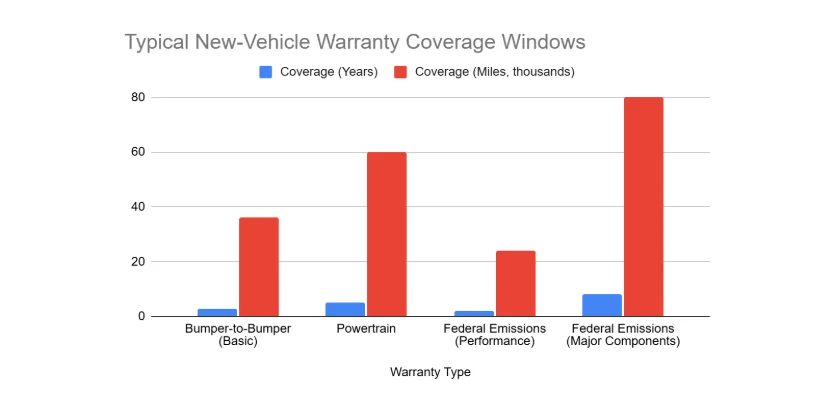
Warranty Coverage Windows We Look At
Most manufacturer warranties aren’t a single number; they’re layered, and the layer that applies often decides whether a repair is free and whether the clock is still running on a Lemon Law claim. The chart below shows the typical structure we look for (exact terms vary by manufacturer, so we always confirm yours from your warranty booklet or window sticker):
Defect Categories We Handle Most Often
In our experience representing Michigan drivers, defects don’t distribute evenly across a vehicle. Some systems generate a disproportionate share of the repair orders that eventually turn into a Lemon Law claim. The chart below reflects the general mix of defect types we see across our caseload; it’s a reflection of our practice experience, not a government statistic, but it’s a useful guide to where problems tend to concentrate:
Engine and Powertrain Defects
Stalling, loss of power while driving, rough idling, oil consumption, and engines that will not reliably start are among the most serious defects we see, because they tend to raise safety concerns as well as reliability concerns. We also handle drivetrain problems such as failed turbochargers, timing chain issues, and engines that require replacement rather than repair.
Transmission Defects
Hard or delayed shifting, slipping between gears, shuddering at highway speed, and transmissions that need to be rebuilt or replaced show up constantly in the repair orders we review. Because a transmission failure almost always keeps a vehicle in the shop for an extended stretch, these cases often satisfy the days-out-of-service test even when the number of visits alone would not.
Electrical, Infotainment, and Software Defects
Modern vehicles run on dozens of interconnected computer modules, and this category has grown steadily in our practice. We see dashboard warning lights that never resolve, batteries and charging systems that repeatedly fail, backup cameras and sensors that malfunction, infotainment screens that freeze or reboot, and advanced driver-assistance systems (lane keeping, automatic braking, adaptive cruise) that behave unpredictably.
A defect doesn’t have to be dangerous to qualify it has to impair use or value, but when a software glitch also affects safety systems, we treat it as a priority case.
Brakes, Steering, and Suspension Defects
Pulling to one side, grinding or squealing brakes, premature rotor and pad wear, steering that binds or wanders, and clunking or vibration from the suspension are defects we take seriously because they go directly to whether a vehicle is safe to drive every day. We frequently see these problems documented across multiple repair visits before a manufacturer acknowledges a pattern.
Airbags and Safety Restraint Defects
False airbag warning lights, airbags that deploy without cause, seatbelt pretensioners that misfire, and occupant-sensing systems that misread whether a seat is occupied are among the defects that concern us most, given what these systems are designed to do in a crash. If your vehicle has an unresolved restraint-system warning, we want to hear from you regardless of how many repair attempts you’ve had.
Other Defects We Evaluate
Beyond the categories above, we’ve also brought claims involving persistent fuel-system and check-engine-light issues, HVAC systems that won’t heat or cool properly, water leaks that damage the interior or electrical components, paint and body defects that go beyond cosmetic imperfection, and unusual odors or fumes entering the cabin.
What we generally do not pursue as Lemon Law defects are purely cosmetic issues, wear items like tires and wiper blades, damage caused by an accident or by the owner, and problems traceable to aftermarket parts or modifications.
How Many Repair Attempts Is Enough?
Michigan law does not give any defect category special treatment. Regardless of whether the problem is in the engine, the electrical system, or the brakes, the same two-part test applies: a reasonable number of repair attempts is presumed once the same defect has been through 4 or more repair visits within 2 years, or once the vehicle has been out of service for 30 or more cumulative days within the warranty term or the first year of ownership, whichever comes first. We cover the notice requirements, timelines, and refund calculation in detail in our full Michigan Lemon Law guide.
What We’ll Need From You to Evaluate Your Vehicle
Whatever the defect, the documents that let us evaluate a case quickly are the same. When you contact us, it helps to have:
- Your purchase or lease agreement
- Your finance agreement, if the vehicle was financed
- Every repair invoice and repair order for the defect, including ones marked “no problem found”
- Your registration and/or title
- Any written communications with the manufacturer or dealer about the problem
- Photos or video of the defect in action, when possible (a warning light, a fluid leak, a noise)


Talk to a Michigan Lemon Law Attorney About Your Vehicle
No matter what’s gone wrong with your car, truck, SUV, or van — an engine that won’t start, a transmission that slips, a screen that freezes, or an airbag light that won’t go off — we’d like to review your documents and tell you where you stand. Consultations cost you nothing, and if we take your case under Michigan’s Lemon Law, the manufacturer, not you, pays our attorney fees and costs.
Adam S. Alexander, Alexander, PLLC
17200 W. Ten Mile Rd., Ste. 200, Southfield, MI 48075
Sources
- Michigan Compiled Laws 257.1401–257.1410 (New Motor Vehicle Warranties Act, “Lemon Law”), legislature.mi.gov
- Michigan Department of Attorney General, Consumer Protection – Lemon Law, michigan.gov
- Magnuson-Moss Warranty Act, 15 U.S.C. § 2301 et seq.
- National Highway Traffic Safety Administration, Recalls and Defect Investigations, nhtsa.gov