

How Many Repair Attempts Are Required Under Michigan’s Lemon Law
| Michigan presumes a vehicle qualifies as a lemon once the same defect has been the subject of four or more repair attempts. That number is only part of the picture. The attempts have to fall within specific timing windows; they have to address the same underlying defect rather than unrelated symptoms; and the manufacturer is entitled to one final attempt after written notice before a claim can move forward. This page walks through each of those pieces in detail, since they are where many otherwise strong cases run into trouble. |
The Short Answer: Four Repair Attempts
Under MCL 257.1403(5)(a), Michigan presumes a manufacturer has had a reasonable number of attempts to repair a vehicle once the same defect or condition has been subject to repair a total of four or more times. That fourth attempt is also the manufacturer’s final repair opportunity, which the law requires before a consumer can pursue a refund or replacement.
In practice, this usually means three attempts happen in the normal course of ownership, written notice goes to the manufacturer after the third attempt, and the fourth attempt is the formal final repair opportunity.
The Two Timing Windows That Also Apply
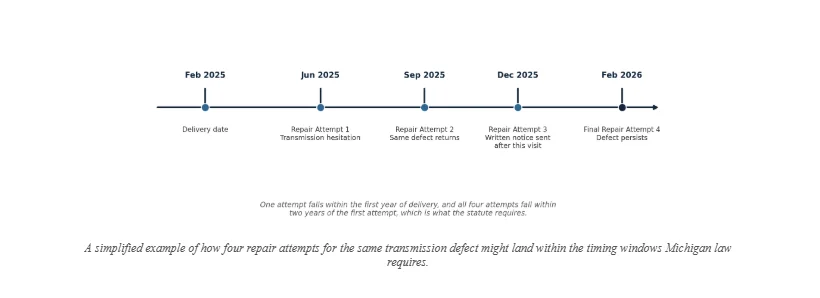
The four attempts do not float freely across the life of the vehicle. At least one repair attempt generally has to occur within the first year following delivery to the original consumer, and all repair attempts, from the first to the final one, have to occur within two years of the date of that first attempt.
A defect that surfaces late, or a repair history that stretches out over several years with long gaps between visits, can fall outside these windows even if the same problem keeps recurring. This is one of the most common places we see a case complicated by timing rather than by the underlying defect itself.
A simplified example of how four repair attempts for the same transmission defect might land within the timing windows Michigan law requires.
What Counts as “the Same Defect or Condition”
Every attempt has to address the same defect or condition, not just any repair activity on the vehicle. This is where manufacturers most often push back. A transmission that hesitates on one visit and then jerks or clunks on the next is generally the same underlying defect described in different terms by different service writers, not two separate problems.
On the other hand, a repair for a windshield wiper motor followed by a repair for an unrelated brake noise are genuinely different issues, and neither one helps build a count toward the other. The service writer’s chosen wording on the repair order matters less than what you can show the vehicle was actually doing each time, which is why we always ask clients to describe the symptom in their own words alongside whatever the dealer wrote down.



Does a “No Problem Found” Visit Still Count?
Generally yes. If you brought the vehicle in because a defect was occurring and the technician could not reproduce it, that visit still documents that you reported the problem on that date, and it still counts as an opportunity the manufacturer had to address it.
A no problem found notation is common with intermittent electrical faults and certain transmission issues, and it is far more useful to your case than not reporting the problem at all. What matters is that your description of the symptom is consistent and specific across every visit, whether or not the technician was able to replicate it that day.
Do the Repairs Need to Happen at the Same Dealership?
No. Repair attempts can happen at any authorized dealership for the vehicle’s brand, and they still count toward the same total as long as they address the same defect. This comes up often for clients who move, who bought the vehicle in one city and live in another, or who simply had a bad experience at one dealership and switched to another. What matters is that the repairs were performed by the manufacturer or an authorized repair facility, not that they happened in the same building each time.
Keeping records organized across multiple dealerships is worth the extra effort. Each dealership’s service department only has visibility into its own repair orders, so if you switch locations partway through, we ask clients to keep a personal copy of every invoice rather than relying on the manufacturer’s own records to connect the dots later.
What if the Fourth Attempt Actually Fixes the Problem?
Then there is generally no claim to pursue, at least not for that defect. Michigan’s lemon law requires that the defect continue to exist. If the final repair attempt genuinely resolves the issue and it does not return, the manufacturer has done what the law requires of it. This is different from a repair that appears to work for a few weeks before the same symptom comes back, which is a pattern we see often enough that we recommend continuing to monitor the vehicle closely even after a repair that seems successful at first.


What if My Warranty Expires Before the Final Repair Attempt?
Repairs required under Michigan’s lemon law still have to be made even if the manufacturer’s express warranty has expired by the time the final attempt happens, as long as the repair is a continuation of the original attempt to fix a defect that was first reported while the warranty was still active. A defect reported in month eleven of a twelve-month warranty does not lose its protection just because the fourth attempt happens after month twelve.
This provision matters more than it might seem, since manufacturers occasionally point to an expired warranty as a reason to decline a final repair attempt altogether. Michigan law does not allow that outcome. If your first report of the defect happened while the vehicle was still covered, the manufacturer’s obligation to complete the repair process carries forward even after the warranty period ends.
Trying to Count Your Repair Attempts Call (248) 246-6353 or request a free case review online. Alexander Law reviews your repair orders and tells you exactly where your count stands and whether the timing works in your favor. |
Related Reading
- What Qualifies as a Lemon in Michigan, for the full two-part legal standard
- Michigan Lemon Law: The Complete Guide, for the days out of service alternative and the final repair notice process
- Common Lemon Law Defects in Michigan, for how to document a defect so it holds up across repair visits