

Deadlines and Time Limits Under Michigan’s Lemon Law
| A Michigan lemon law claim runs on more than one clock at the same time. There is a window for the qualifying repair attempts or days out of service to accumulate, a specific countdown once you hit either threshold, and a separate deadline for actually filing a lawsuit if a fair settlement never materializes. Missing any one of these can weaken or end a claim regardless of how strong the underlying defect is. This page puts every deadline in one place. |
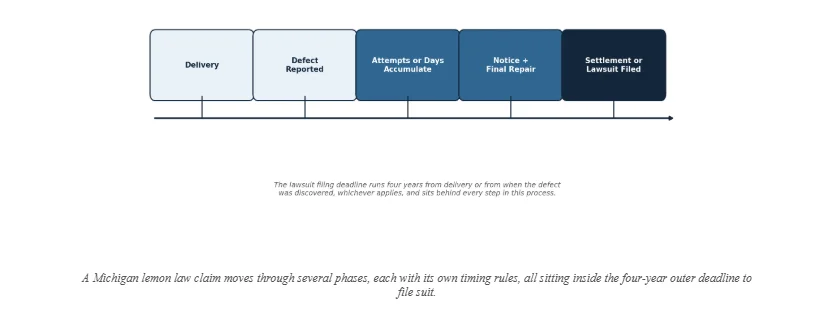
A Michigan lemon law claim moves through several phases, each with its own timing rules, all sitting inside the four-year outer deadline to file suit.
The Four Year Deadline to File a Lawsuit
Michigan’s lemon law statute does not set out its own deadline for filing a lawsuit. When a specific statute is silent on timing, Michigan courts generally apply the Uniform Commercial Code’s four-year limitations period for breach of contract and warranty claims under MCL 440.2725, since a lemon law claim is fundamentally a warranty dispute.
That four-year clock generally starts when the vehicle was delivered, though if the warranty explicitly covers future performance of the vehicle, the clock can start when the defect was or should have been discovered instead. In practice, this means the earlier a claim moves forward after a defect becomes clear, the more room there is to negotiate, litigate, and see the case through without the deadline becoming a factor.
As an example, a vehicle delivered in March 2023 with a transmission defect first reported in June 2023 would generally need a lawsuit filed by March 2027 under the tender of delivery rule, four years from the delivery date rather than four years from when the problem was reported. Most Michigan lemon law cases resolve well before this deadline becomes relevant, but it matters most in cases that involve a long, unsuccessful settlement negotiation, a manufacturer that changes position repeatedly, or a defect that was not immediately obvious.
How the Discovery Rule Can Extend the Clock
Most new vehicle warranties promise to repair or replace defects that arise during a specific period, rather than promising the vehicle will remain defect free into the future. Michigan courts have generally treated this kind of repair or replace language as not explicitly extending to future performance, which means the four year clock typically runs from delivery rather than from discovery.
Some warranty language is written differently, and if a warranty does explicitly promise future performance of the vehicle, the four year period can instead start when the defect was or reasonably should have been discovered. Because this distinction depends on the exact wording of your warranty, we review it directly rather than assuming one rule applies across every manufacturer.
The Two Qualifying Windows, and a Detail Easy to Miss
We cover the repair attempt threshold and its own timing windows in full on our How Many Repair Attempts Are Required page. The days-out-of-service path has a timing detail that is easy to overlook. Thirty or more days out of service must occur during the manufacturer’s express warranty term, or within one year from the date of delivery, whichever comes first.
That means a longer warranty does not automatically give you more time on this particular path if the one-year mark arrives first. We check both dates on every case rather than assuming the warranty term controls.



The Notice and Final Repair Countdown
Once you are approaching either qualifying threshold, a specific notice countdown begins. After the vehicle has been out of service at least twenty-five days, or after the third repair attempt for the same defect, written notice by return receipt service has to go to the manufacturer describing the need for repair, before you can pursue a refund or replacement.
The manufacturer then has to direct you to a reasonably accessible repair facility, and once the vehicle is delivered there, the manufacturer has five business days to complete the final repair. Skipping or mishandling this notice step is a technical error that has caused real cases to be dismissed, which is why we draft and send this notice by certified, return receipt mail for every client at no additional charge.
Does a Settlement Offer or Ongoing Negotiation Pause the Clock
Generally, no. Receiving a settlement offer, going back and forth with a manufacturer’s representative, or waiting to see if a goodwill repair holds up does not by itself pause the four-year filing deadline. We have seen consumers negotiate informally for months without realizing the underlying deadline kept running the entire time. If negotiations are dragging on as a deadline approaches, filing suit to preserve your rights while negotiations continue is often the safer path, and settlement remains possible even after a lawsuit is filed.
What Happens if the Warranty or a Deadline Runs Out Mid-Process
A defect reported while the warranty was still active keeps its protection even if a required repair happens after the warranty term ends, since the repair is treated as a continuation of the original attempt. Natural disasters, war, invasion, strikes, and fires can also extend the one-year, thirty-day, and five-day periods described above if repair services genuinely were not available to you during that time. These extensions do not apply to the four-year lawsuit deadline itself, which is a separate, harder line.
| Deadline | The Rule | Where We Cover It in Detail |
| Repair attempts | 4 or more attempts, all within 2 years of the first attempt | How Many Repair Attempts Are Required |
| Days out of service | 30 or more days, during the warranty term or within 1 year of delivery, whichever is earlier | This page |
| Written notice | Sent after the 3rd attempt or 25th day out of service, by certified return receipt mail | This page |
| Final repair | 5 business days after delivery to the manufacturer’s designated repair facility | This page |
| Lawsuit filing | 4 years from delivery, or from discovery of the defect if the warranty covers future performance | This page |


Why Acting Early Protects Every Other Deadline
Each deadline above depends on accurate dates from the one before it. A vague memory of when a repair happened, or a missing invoice from an early visit, can make it difficult to prove exactly when the qualifying threshold was met, which in turn affects when notice should have gone out and when the four year clock actually started running. We ask every client to gather purchase paperwork and repair orders as early as possible, not because a case will fall apart without them, but because the dates on those documents are what let us calculate every deadline correctly the first time.
Worried You Are Running Out of Time Call (248) 246-6353 or request a free case review online. Alexander Law reviews your dates and tells you exactly where you stand on every deadline that applies to your case. |
Related Reading
- What Qualifies as a Lemon in Michigan, for the full two-part legal standard
- How Many Repair Attempts Are Required, for the repair attempt path in detail
- Common Lemon Law Defects in Michigan, for how to document dates and defects together