
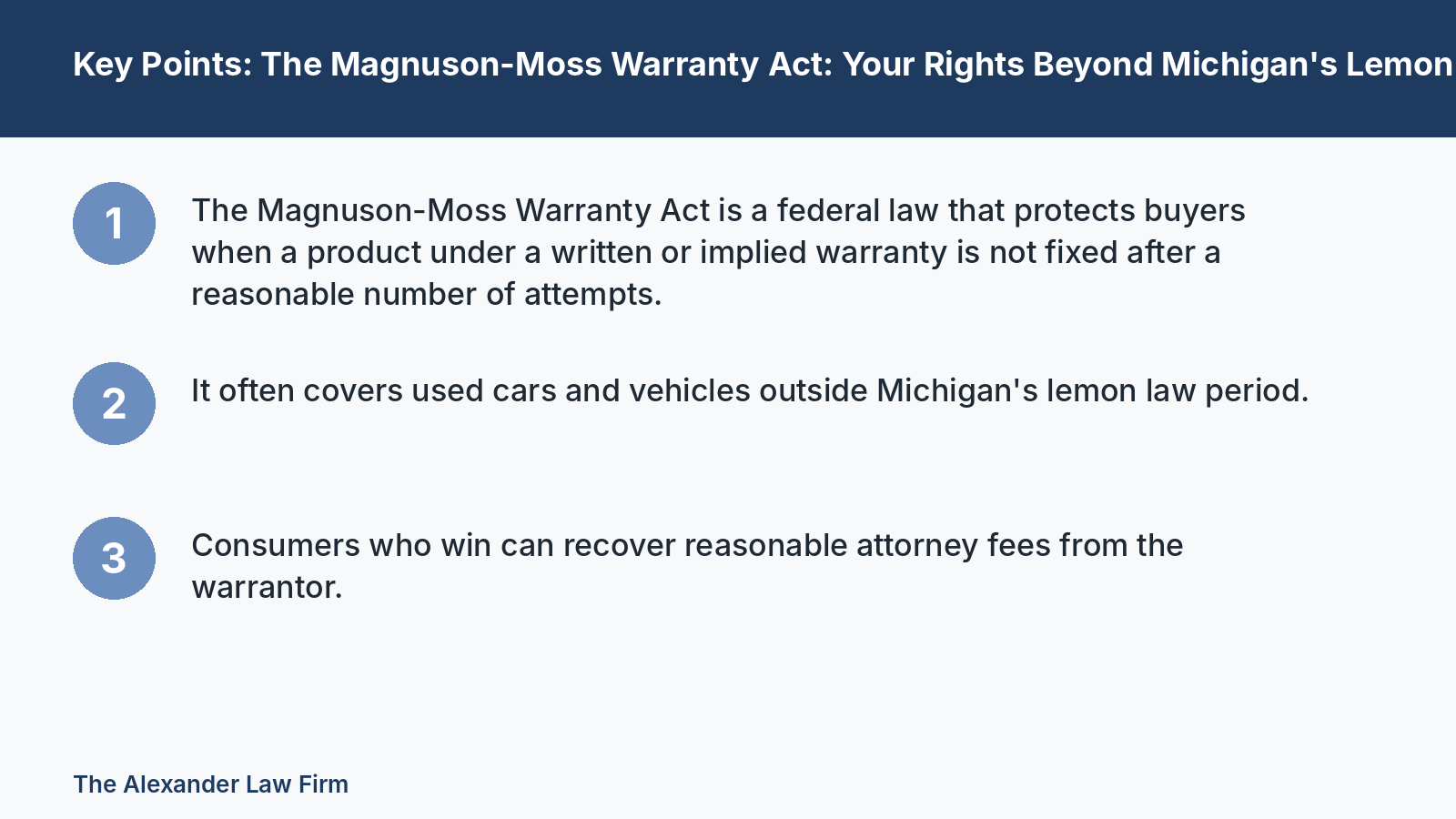
The Magnuson-Moss Warranty Act is a federal law that protects buyers when a product under a written or implied warranty is not fixed after a reasonable number of attempts. It often covers used cars and vehicles outside Michigan’s lemon law period. Consumers who win can recover reasonable attorney fees from the warrantor.
Reviewed by Adam Alexander, attorney at The Alexander Law Firm. Last reviewed November 2026.
The Magnuson-Moss Warranty Act is a federal law that protects consumers when a product covered by a written warranty, or by an implied warranty, fails and the warrantor does not fix it within a reasonable number of attempts. It often fills gaps left by Michigan’s lemon law, which mainly covers new vehicles in their first year. Magnuson-Moss can apply to used cars sold with a warranty, vehicles outside the state lemon law period, and many other consumer products. If you win, the law allows you to recover reasonable attorney fees from the warrantor.
Many Michigan drivers assume they have no options once a vehicle is used or more than one year old. That is often not true. When a dealer or manufacturer gave a warranty and failed to honor it, federal law may still provide a remedy.
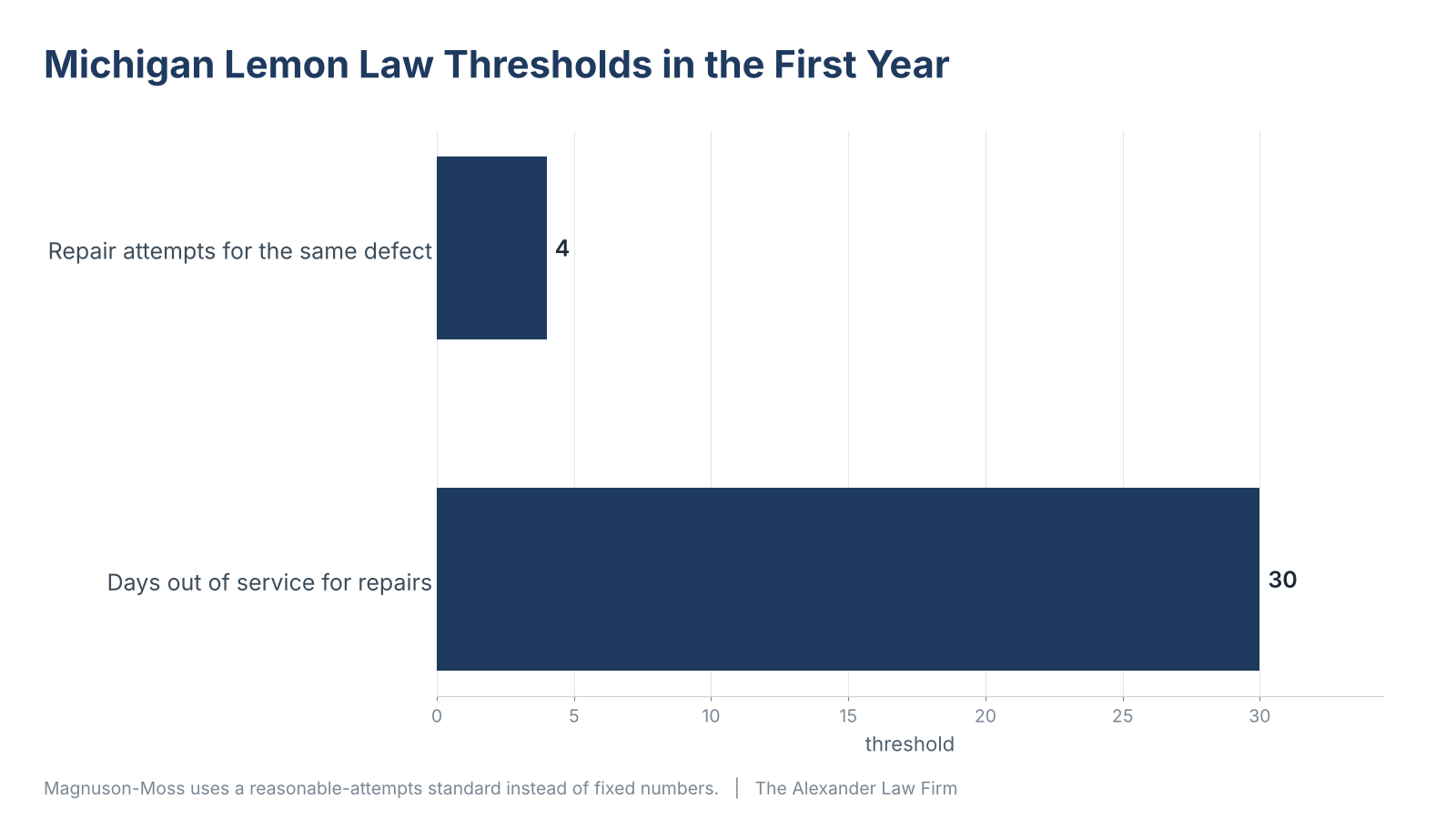
Michigan Lemon Law Compared With Magnuson-Moss
Feature | Michigan Lemon Law | Magnuson-Moss Warranty Act |
|---|---|---|
Vehicles covered | New vehicles, with defects reported in the first year or warranty period | New and used vehicles with a written or implied warranty |
Other products | No | Yes, many consumer products with warranties |
Specific number of attempts or days out of service | A reasonable number of attempts or reasonable time | |
Attorney fees | Available to a prevailing consumer | Available to a prevailing consumer |
Who Is Protected
- Buyers of new vehicles whose problems began after the state lemon law period
- Buyers of used vehicles sold with a dealer warranty or certified pre-owned warranty
- Buyers of vehicles still under the manufacturer’s original warranty
- Consumers with defective appliances, electronics, and other warrantied products
Used cars sold strictly “as is,” with all implied warranties properly disclaimed, often fall outside the law. However, a dealer that sells a service contract within 90 days of the sale generally cannot disclaim implied warranties.
What You Must Show
A Magnuson-Moss claim generally requires showing that the product was covered by a warranty, that a defect covered by the warranty existed, that you gave the warrantor a reasonable opportunity to repair it, and that the warrantor failed to fix it. Repair orders, invoices, and communications with the dealer or manufacturer are the core evidence.
Full and Limited Warranties
Written warranties must be labeled full or limited. A full warranty requires the warrantor to fix the defect within a reasonable time without charge, and if it cannot, to offer a refund or replacement. Most vehicle warranties are limited warranties, which still must be honored as written and still support a claim when the warrantor fails to fix covered problems.
What You Can Recover
Depending on the facts, a successful claim may lead to repair of the defect, a refund or replacement, or damages for the reduced value of the product. Damages may also include incidental costs, such as towing and rental expenses caused by the defect. Many cases resolve through negotiation once the warrantor understands that attorney fees are at stake.
Common Used Car Situations
Used vehicle buyers often run into problems with certified pre-owned warranties, dealer powertrain warranties, and remaining factory coverage on vehicles a few years old. Recurring transmission, engine, electrical, and infotainment problems are common examples. When the dealer keeps saying the problem cannot be duplicated or the repair does not hold, documentation of each visit becomes especially important.
Why Fee-Shifting Matters
Warranty disputes often involve amounts that would be too small to justify hiring a lawyer by the hour. Magnuson-Moss allows a successful consumer to recover reasonable attorney fees and costs from the warrantor. That makes it practical to pursue claims that might otherwise be abandoned.
Steps to Protect Your Claim
- Keep every repair order and make sure it describes your complaint accurately.
- Give written notice of ongoing problems to the dealer and manufacturer.
- Save your purchase contract, warranty booklet, and any service contract.
- Do not let the vehicle go unrepaired for long periods without documenting why.
- Talk to a lawyer before trading in or selling the vehicle.
Learn more about our Michigan lemon law services, including warranty claims for used vehicles.
Aftermarket Parts and Voided Warranties
Dealers sometimes claim a warranty is void because the owner used aftermarket parts or had routine service done somewhere else. Under the Magnuson-Moss Warranty Act, a warrantor generally cannot require you to use branded parts or dealer service as a condition of coverage, unless those parts or services are provided free of charge.
A warrantor can deny coverage for a specific repair if it shows that the aftermarket part or outside service actually caused the problem. It cannot simply void the entire warranty because a non-branded part is on the vehicle. Keep receipts for all maintenance so you can show the vehicle was cared for properly.
Frequently Asked Questions
Does the Magnuson-Moss Act cover used cars?
Yes, if the used car was sold with a written warranty or an implied warranty that was not properly disclaimed.
What if my car is past Michigan’s lemon law period?
Magnuson-Moss may still apply if the vehicle remains under warranty.
Can I recover attorney fees under Magnuson-Moss?
Yes. A prevailing consumer can recover reasonable attorney fees from the warrantor.
How many repair attempts are required?
A reasonable number, which depends on the defect and the circumstances.
Does Magnuson-Moss cover products other than cars?
Yes. It applies to many consumer products sold with written warranties.
Does using aftermarket parts void my warranty?
Generally no. The warrantor must show the aftermarket part caused the specific problem before it can deny that repair.
What do I have to prove in a Magnuson-Moss claim?
That the product had a warranty, a covered defect existed, the warrantor had a reasonable chance to fix it, and it failed to do so.
Talk to a Michigan Warranty Attorney
The Alexander Law Firm helps Michigan consumers pursue lemon law and warranty claims for new and used vehicles. When you call 248-246-6353, our team will ask about your vehicle, the repairs, and your warranty, then explain your options. Start with a free case review.